
First thought:
In continuing from Lukács, Adorno and Horkheimer take on enlightenment as a power relationship that subdues nature through understanding and knowing. This is not a modern concept; it can be seen in its first instances in myth and language; in magic. But there are differences, as for Lukács, between premodern subject-object relations and their modern counterparts. Magic is an appeal to the mysterious, to the total; it is enacted in a relation of kinship, of expressing. Our new form of enlightenment, scientific rationalism as espoused by Bacon, dominates by disenchanting; power is increased in estrangement over that which it is exerted [VI] . Appearing in the first distinctions between subject and object, it ends with a single relationship between the subject who confers meaning and the meaningless object, between rational significance and its accidental bearer [VII]. In this singular relation, everything collapses away from the subject and into "the rest of the world", becoming meaningless and undifferentiated. Everything is relatable as science and structure; all myths and religions are comparable, equalised, neutered, forming the structure through which we "build" our world. Adorno and Horkheimer argue that the enlightenment, in attempting to disenchant the world, has formed its own techno-cratic enchantment, of debasing self-violation, where nothing human is trusted and concepts of truth and mind become superstitions. It has created societies where the individual is negated and mystery de-mystified through belittlement. The means has been the same means throughout time; the ordering of the universe that reaches back to original myth, is explanation prompted by fear. The fear is the experience of the whole in contrast with the singular; the principle of mana, the primal and unknown substance from which everything springs and holds. It fixes the transcendence of the unknown in relation to the known, permanently linking horror to holiness. Our reaction in explanation is the original ordering, the original control, the original domination. This division has lent itself forward in time to the perverse divisions of reason and non-reason, subject and world, truth and veil. Now we are beyond division into the realm of indivisibility, where everything beyond the realm of subject is interchangeable, everything is the same. Even the self has been stripped of all natural traces, no longer body, soul or ego, but a transcendental logical subject, the reference point of reason. Thus, we have too become interchangeable, we are mere heads to count, either working parts or errors to be corrected. It is reason we have deified at our own expense, reason whose place on the throne was to serve our betterment, fulfilment and happiness, but in its throning we became its kingly subjects and its scientific objects. It became mythic.

Another thought:
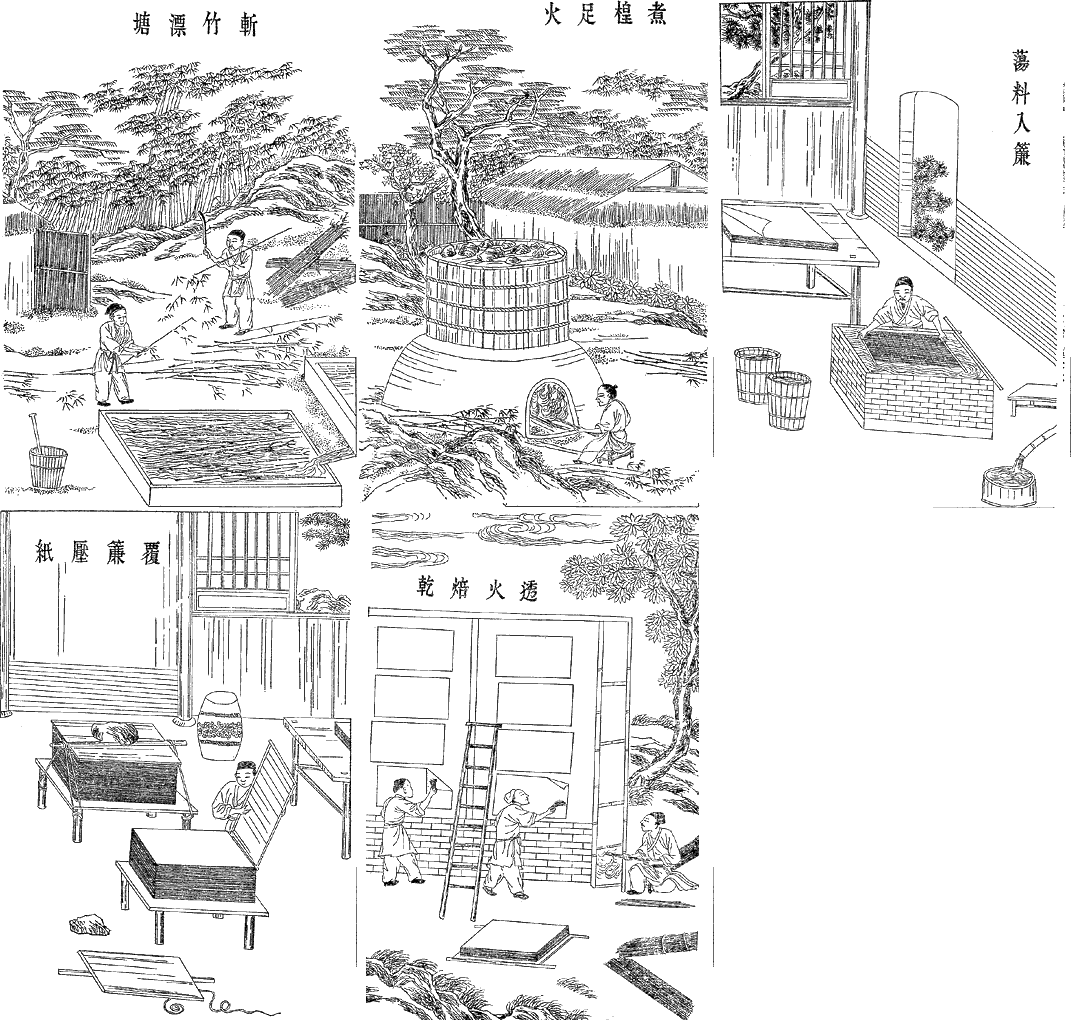
I was thinking about Adorno and Horkheimer's conception of language as evidencing the animate against the inanimate, becoming both itself and something else, identical and not identical. Through the deity speech is transformed from tautology into language [11]. More on this later. For now, Bacon cites printing, artillery and the compass having been arrived at more by chance than by systematic enquiry into nature; rather, all three (four if we break printing down into paper as well) were invented in China, and the methodical investigations were less happenstance than old Bacon imagines. Chinese paper gif; paper to pixels, no magic in that.
So, I got really into the Adorno/H concept of mana, which I found out is not a Greek principle at all (cleverly worded by Adorno), but is a Polynesian concept of the great supernatural power that is everything. I'm still not entirely sure how it fits together, because Marcel Mauss (who Adorno does footnote later in the Dialectic in relation to this principle) in his work on magic and the gift, talks of mana as something one possesses i.e. in the improper observation of gift exchange, one can lose one's mana and therefore prestige. I am not sure whether this is a Maussian view of mana, a manifold meaning, or some specific societal formulation of it. I just borrowed Mauss' general theory of magic from the library so hopefully I will be able to clarify soon. I like Adorno's description of mana as "not a spiritual as opposed to a material substance, but the intricacy of the Natural in contrast to the individual" or in another translation "not a spiritual substance in contradistinction to the material world but the complex concatenation of nature in contrast to its individual link." (I think this one is more poetic) and
"The gasp of surprise which accompanies the experience of the unusual becomes its name" or "The cry of terror called forth by the unfamiliar becomes its name". (This is the second translation and now I prefer the first, which I think places proper emphasis on the unknown and less on the cry of terror. I will definitely have to learn German so that I can better understand these authors I like so much)
A bit more: "mana, the moving spirit, is no projection, but the echo of the real supremacy of nature in the weak souls of primitive men" (here the second translation is quite similar). I think that what I like so much about this concept is the enchantment of nature, but not as "God" or knowable, comprehensible thing, but as the stuff the world, that is magic because it is unknowable and ungraspable rather than being ungraspable because it is magic. I think this is a really important distinction and perhaps the mistaken inversion is why we get stuck upon ideas of Gods etc. Can we find a way to incorporate these ideas of mana and acceptance of the unknown into our society, which must categorise and objectify everything? I am not sure, but I think it is not necessarily about believing in an ancient Polynesian principle, but about being more holistic in our understanding (also, I would like a better word than holistic, if you have one) of the world. It is not a dismissal of science to think of the world imbued with mana, for if we take mana to be the "complex concatenation of nature in contrast to its individual link", it is a way of seeing and understanding rather than a "thing" or a substance. It is an attitude that allows us to encompass more than just one view of the world, for when we privilege one way of seeing, we unavoidably diminish another. So imbuing the world with mana is not thingifying an entity named Mana, rather, it is an attitude of respect for the complexity of ideas, people, things and how they all fit together.


